
AI SEO
Find out what is holding a page back before you rewrite it
Paste a URL, a draft or a keyword. The SEO Analyzer returns a scored report — technical checks, the issues it found, readability, keyword density, search volume and difficulty — so you know what to change and in what order.
What is the AI SEO Analyzer?
The AI SEO Analyzer runs three kinds of check from one screen. URL Analysis crawls a live page and reports its SEO score, title and meta description, load time and status code, the issues it found, and whether the technical basics — HTTPS, mobile rendering, sitemap, robots.txt — are in place. Text Analysis takes a draft instead of a URL and reports word count, reading time, readability, keyword density and specific edits. Keywords takes a term and reports monthly volume, difficulty, CPC and competition, with related terms worth targeting.
The point is ordering. Most SEO advice is a list of everything that could matter; this gives you the handful of things that matter on this page, ranked, with a score you can re-run after the fix to confirm it moved.
Capabilities
What you can do with the AI SEO Analyzer
How it works
Using the AI SEO Analyzer
- 01
Pick the analysis you need
URL Analysis for a live page, Text Analysis for a draft, Keywords for search-demand research.
- 02
Paste the URL, text or keyword
One field. No account setup, no site verification, no crawler to configure.
- 03
Read the scored report
Score, issues, technical checks and recommendations arrive as separate cards rather than one wall of text.
- 04
Fix and re-run
Make the changes it named, run the same analysis again, and check the score moved.
Examples
What good input and output look like
AI SEO Analyzer
Live demoWriting the prompt1/3You type
AmmarAI renders
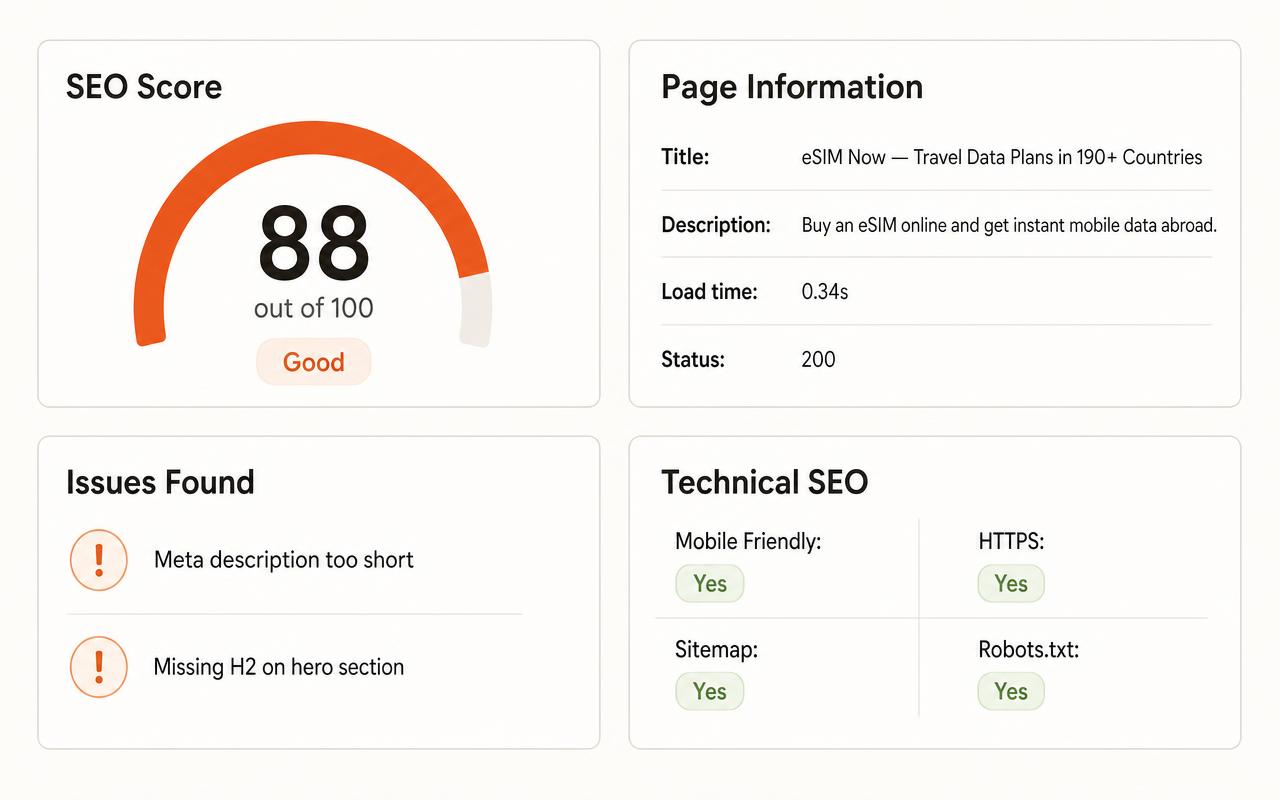
Sample output — the URL Analysis report for esimnow.net: score, page information as the crawler sees it, the two issues found, and the technical checks.
SEO score 88/100. Page title and meta description read back as the crawler sees them, load time 0.34s, status 200. Two issues: the meta description is too short, and the hero section has no H2. HTTPS, mobile rendering, sitemap and robots.txt all pass.
URL analysis
Input
https://esimnow.net
Output
SEO score 88/100. Page title and meta description read back as the crawler sees them, load time 0.34s, status 200. Two issues: the meta description is too short, and the hero section has no H2. HTTPS, mobile rendering, sitemap and robots.txt all pass.
Text analysis
Input
Analyse the eSIM landing page copy before it goes live — 412 words on travel data plans, coverage and activation.
Output
412 words, 2,388 characters, about a 2 minute read. Readability 71/100, fairly easy. Keyword density led by "esim" at 2.4% and "travel data" at 1.8%. Four edits suggested, starting with getting the primary keyword into the first paragraph.
Keyword research
Input
esim for travel
Output
18,100 monthly searches, difficulty 64/100, CPC $1.42, medium competition. Related terms ranked by opportunity: "esim data plan europe" at 3,600 searches and difficulty 44 is the realistic first target, ahead of the head term.
Key features
What the tool gives you
Three analyses, one screen
URL, text and keyword checks sit side by side, so research and on-page work happen in the same place instead of across three subscriptions.
Scores you can re-run
Every report ends in a number. Fix what it named, run it again, and the difference tells you whether the change was worth making.
Technical checks in plain language
HTTPS, mobile rendering, sitemap and robots.txt reported as pass or fail, not as a crawl log you have to interpret.
Demand data behind the keyword
Volume, difficulty, CPC and competition together, so you can tell an ambitious target from an achievable one before writing anything.
Who it is for
People who get the most from this
Small business owners
Check your own site without hiring an agency to tell you the meta description is too short.
Content writers
Run the draft through Text Analysis before filing it, not after the editor sends it back.
Marketers
Size up search demand for a campaign topic before committing budget to it.
Agencies
Produce a scored before-and-after for a client in the time it takes to paste two URLs.
Workflows
Practical ways teams use it
Pre-launch page check
Run the staging URL through URL Analysis the day before launch. The technical card catches a missing robots.txt or a non-200 status while there is still time to fix it.
Deciding what to write next
Run three candidate topics through Keywords and compare volume against difficulty. The one with 3,600 searches at difficulty 44 usually beats the one with 18,100 at 64.
Editing a draft that reads heavy
Text Analysis puts a number on readability and shows which sentences are dragging it down, which is easier to act on than "make it punchier".
Auditing an inherited site
Work through the top twenty URLs, note the scores, and you have a prioritised backlog by the end of the morning.
Tips that improve results
- Analyse the live URL, not a local copy — load time and status only mean something on the real server.
- Treat difficulty and volume together. A high-volume term you cannot rank for is worth less than a modest one you can.
- Re-run the same analysis after each fix so you can attribute the score change to a specific edit.
- Use Text Analysis on the draft, not the published page, so the fixes land before anyone reads it.
- Keyword density is a signal, not a target. If a term is at 2.4% and the copy reads naturally, leave it alone.
Mistakes worth avoiding
- Chasing the score to 100. Past the high eighties you are usually optimising things no reader notices.
- Fixing every issue in the list at once, then having no idea which change moved the number.
- Targeting head terms only, and never ranking for any of them.
- Rewriting for keyword density until the copy stops sounding like a person wrote it.
- Running the analysis once and never again after the page changes.
AI SEO Analyzer FAQ
What is a good SEO score?
Anything in the eighties is healthy. The score is most useful as a before-and-after measure on the same page rather than as a comparison between different sites.
Does it crawl the whole site or a single page?
URL Analysis reports on the page you give it. To audit a section, run the key URLs one at a time and compare the scores.
Where does the keyword data come from?
Search volume, difficulty, CPC and competition are pulled from live search data at the time you run the analysis, so the numbers reflect current demand.
Can I analyse text that is not published yet?
Yes — that is what Text Analysis is for. Paste the draft and you get readability, keyword density and edits before anything goes live.
Does it fix the issues for me?
It names them and recommends the change. For the rewriting itself, hand the recommendations to the AI Writer or the SEO Content Generator.
Related
Tools that pair well with this
AI SEO Content Generator
Draft search-intent-focused content around a topic and target keyword, built to be edited, not published raw.
AI SEOMeta Description Generator
Write meta descriptions sized and phrased to earn clicks in search results — not to boost rankings directly.
AI WritingAI Writer
A flexible writing workspace for drafts, long-form articles, rewrites, and brand-consistent content. Includes templates, the Article Wizard, Smart Editor, and tone controls so every piece stays on-brand.
AI WritingAI Plagiarism Detector
Scan any text against online sources to check for duplicated or AI-generated content, with matched source links.
Try the AI SEO Analyzer free
One AI for everything you create. Start on the free plan and upgrade only when the volume demands it.